Monster Code Activated #001
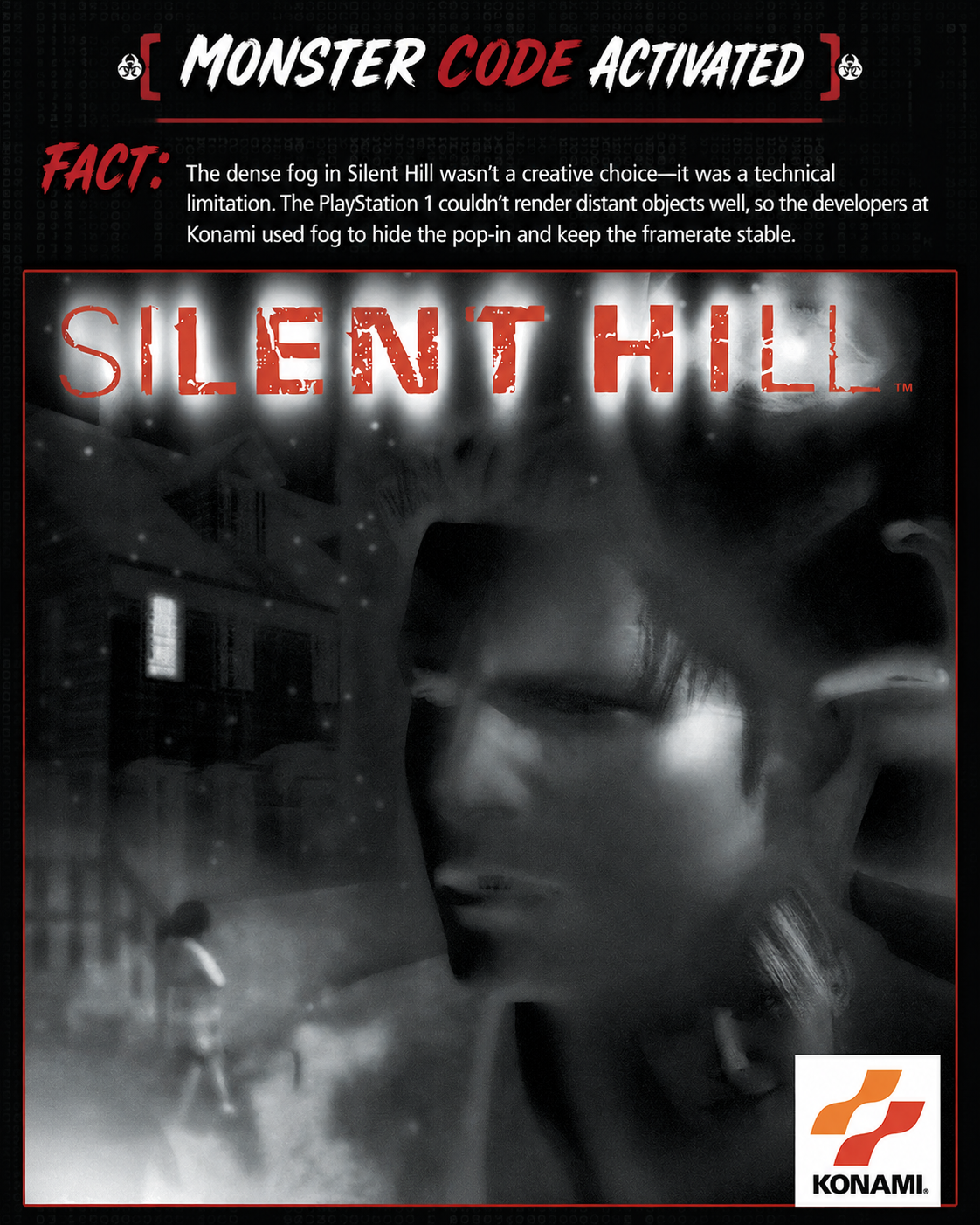
If you’ve ever wondered why Silent Hill is so foggy, the answer might surprise you.
The dense fog that became one of the most iconic elements in Silent Hill wasn’t originally added just to make the game scarier. It was a clever solution to one of the original PlayStation’s biggest hardware limitations.
Ironically, a technical compromise helped create one of the greatest survival horror atmospheres ever made.
Why Does Silent Hill Have So Much Fog?
When Konami’s Team Silent began developing the original Silent Hill for the PlayStation in the late 1990s, they faced a major obstacle.
The PlayStation’s hardware couldn’t render large environments very far into the distance. If players could see too far ahead, buildings, enemies, and objects would suddenly appear out of nowhere—a problem known as pop-in.
Rather than allowing players to constantly see the illusion break, the developers covered the town in dense fog.
The result?
Players could only see a short distance ahead, hiding the console’s rendering limitations while making every street feel unsettling and unpredictable.
A Hardware Limitation Became Horror History
Most technical workarounds disappear with newer hardware.
Silent Hill’s fog did the exact opposite.
Instead of feeling like a compromise, it became the identity of the franchise.
Every step into the unknown forced players to imagine what might be waiting just beyond the fog. That uncertainty created psychological tension few horror games had achieved before.
Sometimes your imagination was more terrifying than the monsters themselves.
Why Silent Hill Still Feels Scary Today
Many horror games rely on jump scares.
The original Silent Hill relied on uncertainty.
The fog worked together with several other unforgettable elements:
- Radio static warning you that monsters were nearby.
- Akira Yamaoka’s haunting soundtrack.
- Narrow streets with almost no visibility.
- Disturbing creature designs inspired by psychological horror.
- A town that constantly made players question reality.
The result was an atmosphere unlike anything players had experienced at the time.
The Legacy of Silent Hill’s Fog
Today, the fog is instantly recognizable to horror fans.
What began as a way to hide the PlayStation’s limited draw distance became one of the most influential design decisions in video game history.
Countless horror games have attempted to recreate the feeling of walking into the unknown, but few have matched what Team Silent accidentally created through technical necessity.
It’s one of gaming’s greatest examples of creativity turning a limitation into an advantage.
Monster Code Activated
Did You Know?
The iconic fog in the original Silent Hill was primarily used to mask the PlayStation’s limited draw distance and rendering capabilities. Rather than exposing the console’s hardware limitations, Team Silent transformed them into one of the most memorable features in survival horror history.
What Do You Think?
Did knowing the real reason behind Silent Hill’s fog change the way you see the game?
Or do you think it would have become a horror classic even without it?
Share your thoughts below—and if you know another hidden piece of horror gaming history, it might become the next Monster Code Activated.